Coming soon · in private beta with founding clubs

Nobody notices a DBS expiring.
ClubKeeper does.

ClubKeeper is the back office for a grassroots football club — the books your treasurer can close, and the register your welfare officer can trust. Built by a committee member, for the committee.

It replaces the team app, the treasurer’s spreadsheets and the safeguarding folder on somebody’s laptop. Fixtures, subs and DBS records stop being three systems that don’t know about each other.

Every DBS chased automaticallyA whole matchday of pitches, allocatedPayroll, funds and a bank reconciliationTwo-factor for admins, treasurers and welfare officers
The ClubKeeper home screen for a club called Demo FC. A sidebar lists Calendar, Teams and players, Qualifications, Chats, Club wall, Documents, Sponsorship, Tournaments and Governance. The main panel flags three membership requests awaiting approval, nine expired qualifications with two outstanding requirements, and six fixtures this week that still need a pitch, above counts of 198 members, 140 players across 10 teams, 68 upcoming events, 24 wall posts and 6 sponsors.

Admin. What needs doing today, before anybody has to go looking for it.

The actual screens

Not mockups — this is the app

Real screens from a club with a full season of history in it, each one photographed by signing in as the person who is actually allowed to see it. The club is invented and so is everyone in it — the app is real, the people are not. Click any of them to open it full size and read the figures for yourself.

Home. What still needs doing today — people waiting to join, checks that have run out, fixtures with no pitch — before anyone has to go looking.

Home1 of 9
The ClubKeeper home screen for a club called Demo FC. A sidebar lists Calendar, Teams and players, Qualifications, Chats, Club wall, Documents, Sponsorship, Tournaments and Governance. The main panel flags three membership requests awaiting approval, nine expired qualifications with two outstanding requirements, and six fixtures this week that still need a pitch, above counts of 198 members, 140 players across 10 teams, 68 upcoming events, 24 wall posts and 6 sponsors.

What still needs doing today — people waiting to join, checks that have run out, fixtures with no pitch — before anyone has to go looking.

The job nobody else does

The expiry nobody was watching

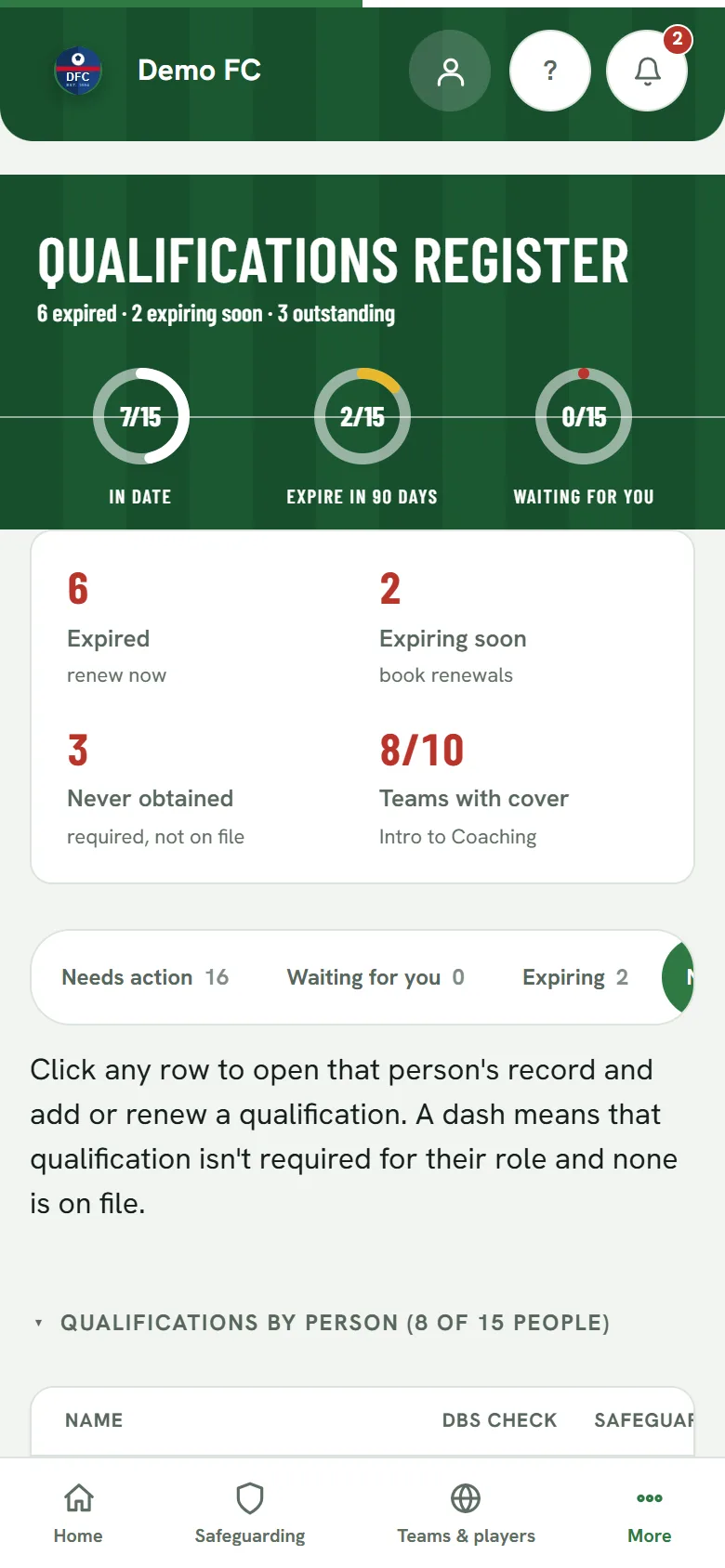
A coach’s DBS lapsed in June. Nobody knew until somebody asked in October. That is not a filing problem — it is a coach on a pitch with children and no valid check, and it is the single most common way a well-run club gets caught out.

  1. Every coach needs three: a DBS, first aid, and safeguarding training. All three expire.
  2. Ninety days before any of them does, the coach is notified — with a link to the exact one.
  3. The Welfare Officer is told too, so it is never one person’s memory, and it asks again every 14 days until it is done.
  4. The coach uploads the certificate themselves; it stays awaiting review until an officer confirms the dates.

It stops asking the moment it’s renewed.

Whichever nation you play in — DBS in England and Wales, PVG in Scotland, AccessNI in Northern Ireland. The FA’s own portal holds the record; nothing there chases it, and nothing there tells your secretary that Saturday’s coach is no longer covered.

The other job nobody else does

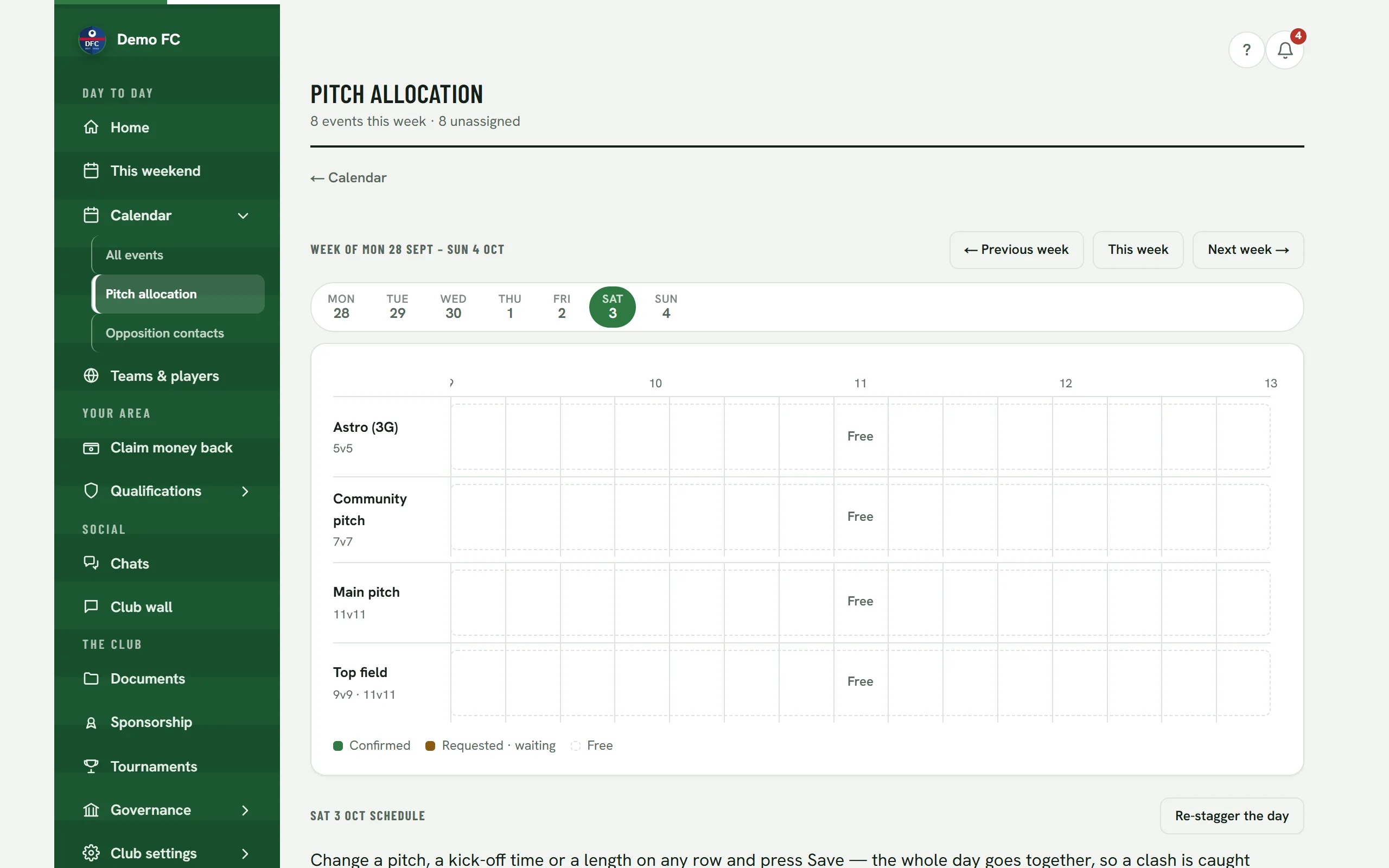
A whole matchday of pitches, allocated

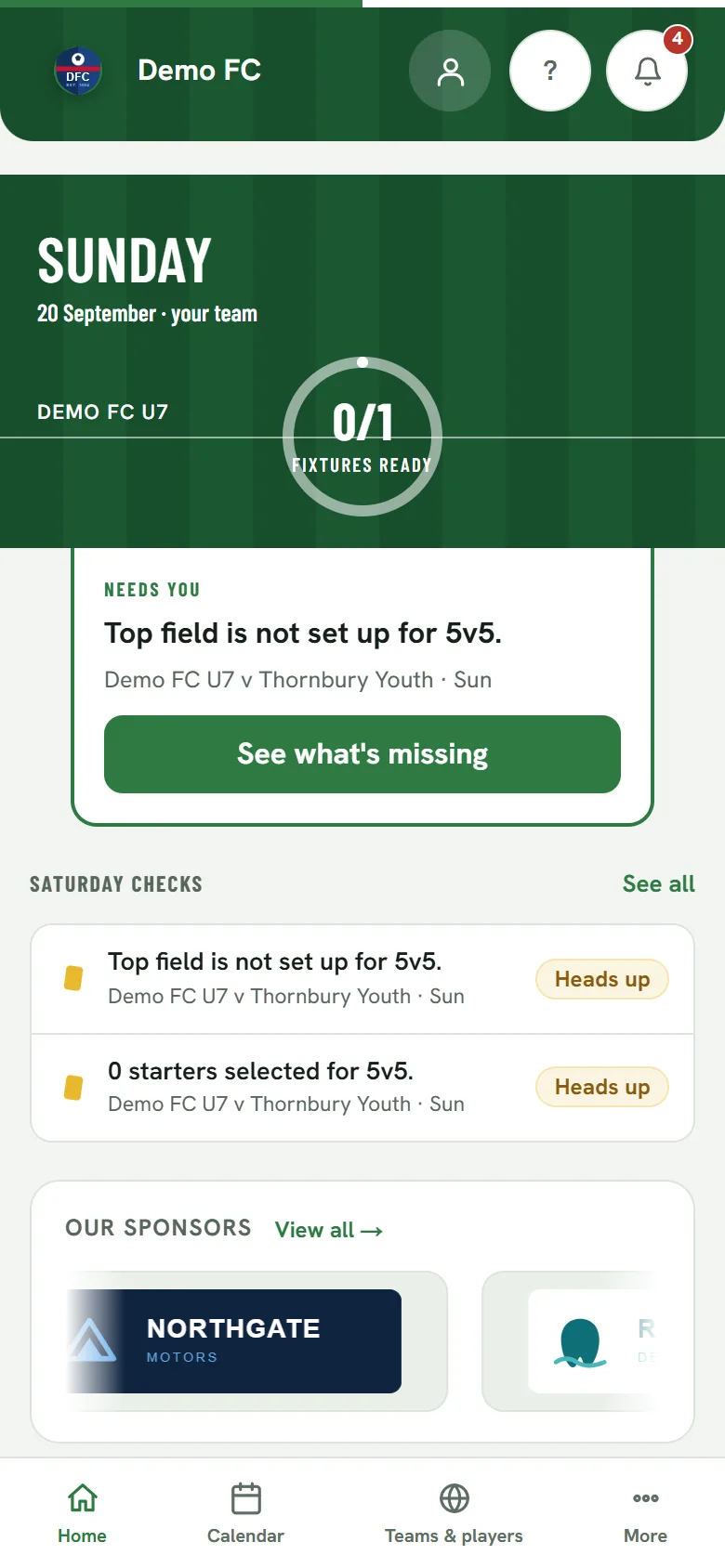
Ten fixtures, four pitches, three different formats, one morning. By hand that is an hour with a paper grid and a rubber — and it is the job that has a coach ringing the secretary at eight o’clock because two teams have turned up to the same square of grass.

  1. Tell it which pitches you have and what each one can host — the 3G astro for 5v5, the top field for 11v11.
  2. It picks a pitch for every fixture that hasn’t got one — the right size of pitch for the age group, and around everything already booked that day.
  3. Nothing changes until you say so. Don’t like what it suggests? Throw it away.
  4. Then set a pitch’s kick-off times in one go — staggered back to back, all of them on screen against each other rather than one row at a time.

Two teams cannot end up on the same pitch at the same time — even if two people book at the same moment.

For the treasurer

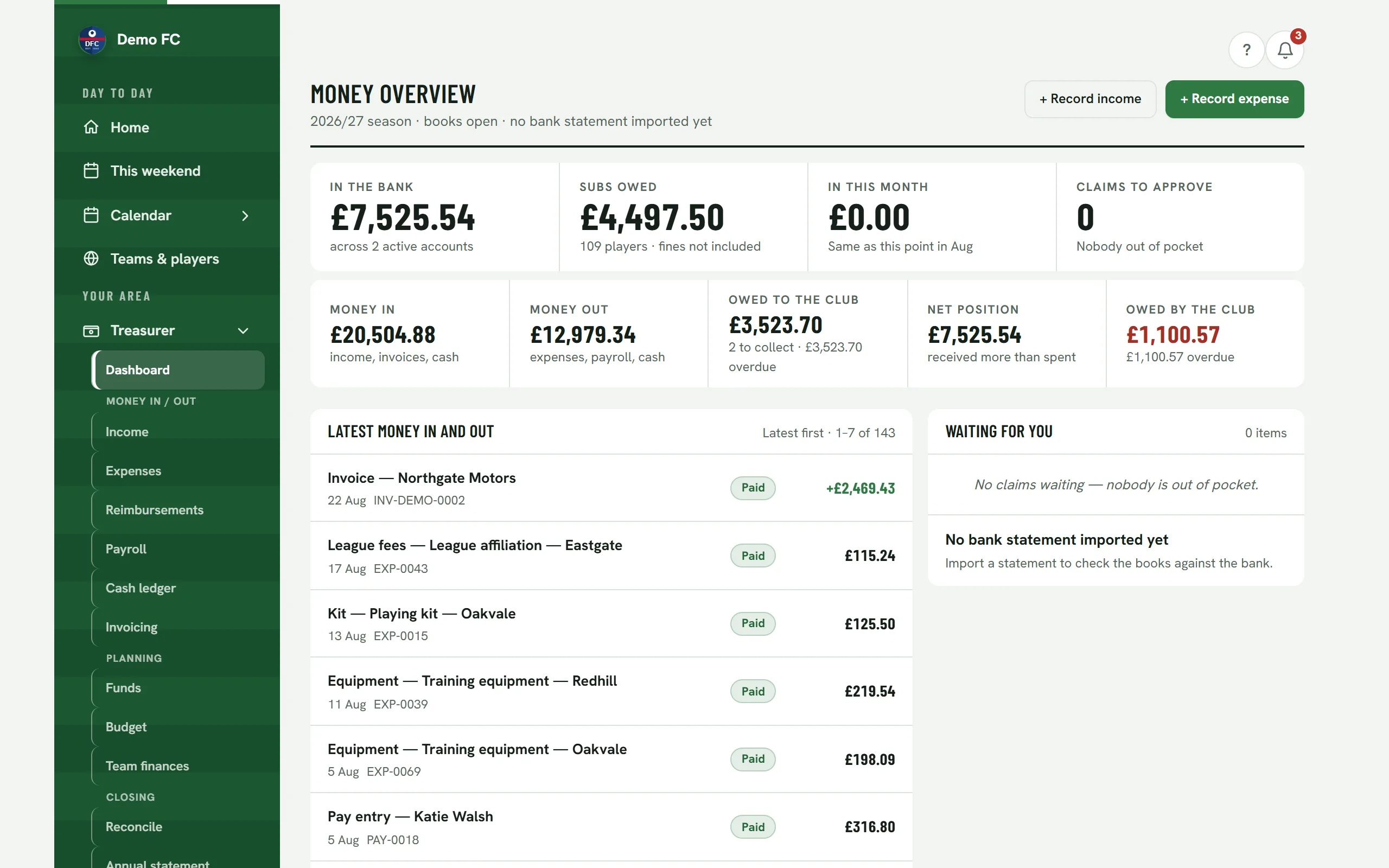
Books, not a cashbook

Most club software records what came in and what went out, then hands you a spreadsheet in May. This is the whole job — fifteen screens behind one Treasurer menu, with the controls somebody is entitled to ask you to point at.

Recording it

  • Income and expenses, each against a category and a fund
  • A cash ledger for the gate money and the tuck shop, kept apart from the bank
  • The receipt lives on the transaction — attached to the record, not in an inbox
  • Log a bill when it arrives, tick it off when it’s actually paid — so you can always see what is still to go out

Giving it structure

  • Proper account headings, so the same kind of spending lands in the same place every season
  • Ring-fenced funds, so tour money and kit money cannot quietly become the same money
  • A budget per fund, tracked against real spend as the season runs
  • Team finances — what each team has raised and what it has cost

Getting money in

  • Subs by card, weekly, monthly or seasonal, into the club’s own Stripe account
  • Invoices to anyone outside the club — sponsor, council, another club — with a pay-by-card link and automatic chasing
  • Sponsors with a deal value and a renewal date, so a lapsing sponsorship is something you see coming

Paying money out

  • Payroll and payslips for paid coaches, with the pay records kept
  • More than one bank account, with money moved between them recorded once, not twice
  • Every payment tied to the fund it came out of

Controls

  • Bank reconciliation against an imported statement — see below
  • A period lock, so last year’s figures cannot move after you have reported them
  • A record of who changed what, and when — one your own committee can read, not just us

Reporting

  • Receipts and payments for the AGM, straight from the ledger, clearly marked as your club’s own figures rather than examined accounts
  • An annual statement for the financial year you set
  • Download it all to a spreadsheet whenever you like, without asking us

Matching the bank statement is the part worth seeing. Upload the statement and it goes through every line working out what each one was: the card payments Stripe paid you in a lump three days later, a payment with your invoice number in it, an amount and a date that can only be one thing, one payment covering several bills at once, money you moved between your own accounts. Nine ways of recognising a line, and it tries the surest ones first.

And it learns. Say yes to a match and it remembers the part of that bank line that stays the same each month, ignoring the reference numbers that never repeat — so it knows the same payee next time. It never changes your books on its own. Not even when it is certain. It suggests, you decide — because a wrong match that has already been applied costs you far more than a line still waiting for an answer.

Xero sync is coming soon — a £25/month add-on for clubs whose accountant wants the figures in their own system, charged only from the day it is released.

And two more nobody automates

The jobs that eat a volunteer’s Sunday

Neither of these is a feature anybody asks for by name, because no club has ever been offered them. Both are among the longest jobs on a committee’s year.

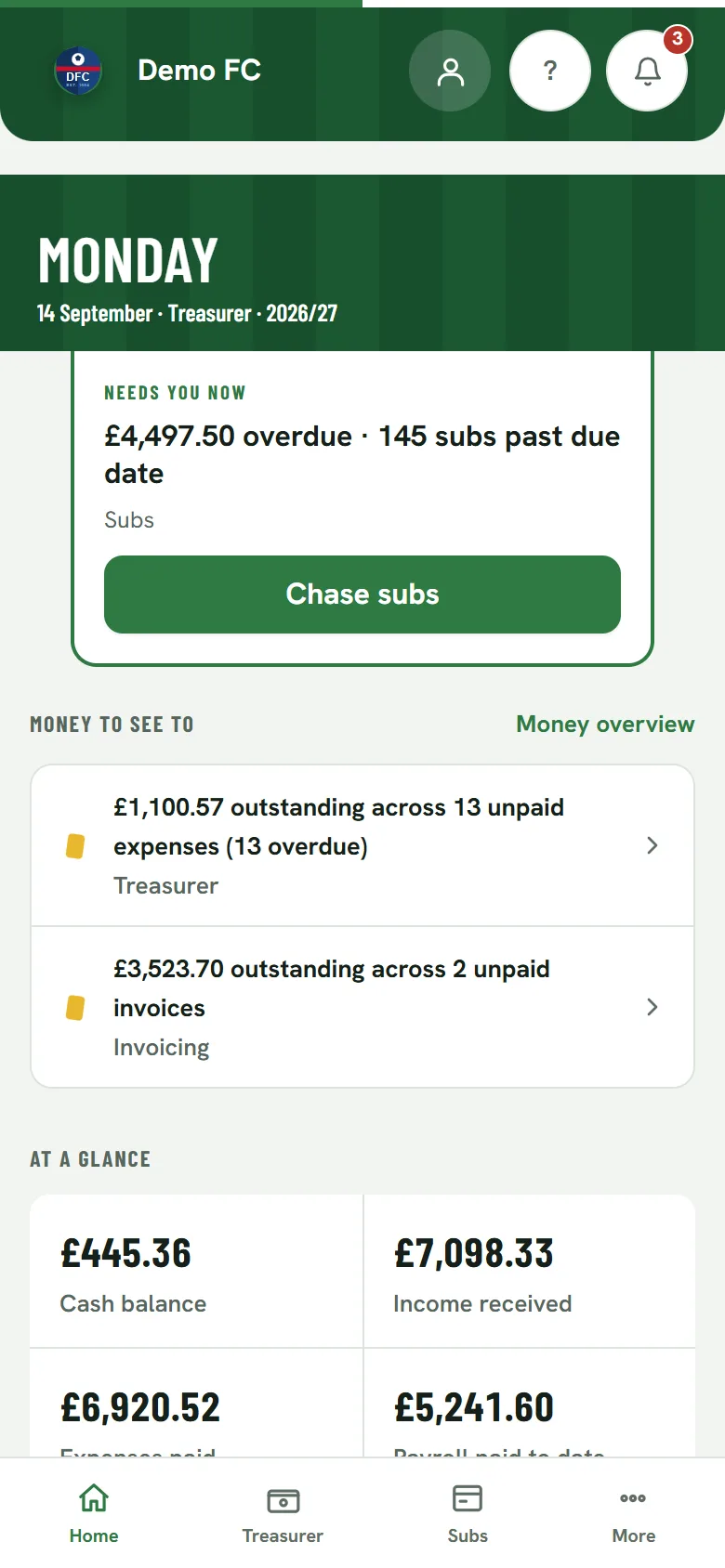
A tournament, end to endEntries, groups, knockout rounds, referees scoring from their phones, and it builds the running order for the day. It sorts teams level on points properly, warns you when a team is down to play twice at once, and lets you push the whole day back when the morning slips. Public results page for parents included. £30 one-off, which gives you the tournament engine for a calendar month.
Invoicing somebody outside the clubA sponsor, the council, another club. A real invoice with a pay-by-card link on it, chased automatically, and matched back to the bank statement when it lands.
What happens

Five more jobs that stop being your problem

Not a list of what is included — what actually happens, and when, once your club is on it. One of these is somebody on your committee this season.

Treasurer · the 1st of the month

Subs collect themselves

  1. ClubKeeper raises every family's invoice and takes the card payment.
  2. The money lands in the club's own Stripe account — never ours.
  3. It marks the invoice paid and tells the guardian.
  4. When Stripe pays out a lump sum, it matches that deposit back to the charges inside it.

The treasurer doesn't chase anyone. They look.

Secretary · September

A new player turns up

  1. Give the family your club’s join code.
  2. The parent registers the child and gives the consents themselves; no staff member ticks it for them.
  3. Their FA registration tracks through submitted, awaiting photo, awaiting ID, approved — with a waiting-since date.
  4. Chase the one thing that is actually missing, instead of the whole form.

August stops being a fortnight of paperwork.

Secretary · Saturday, 8am

The pitch is under water

  1. Postpone the fixture. Every reply already given survives it.
  2. Guardians and coaches are told, and it shows as postponed on the calendar and both home screens.
  3. Re-date it when you know, and it keeps its history rather than becoming an unrelated new fixture.
  4. Auto-allocate the rest of the day around the gap it left.

Nobody drives to a locked car park.

Coach · Thursday night

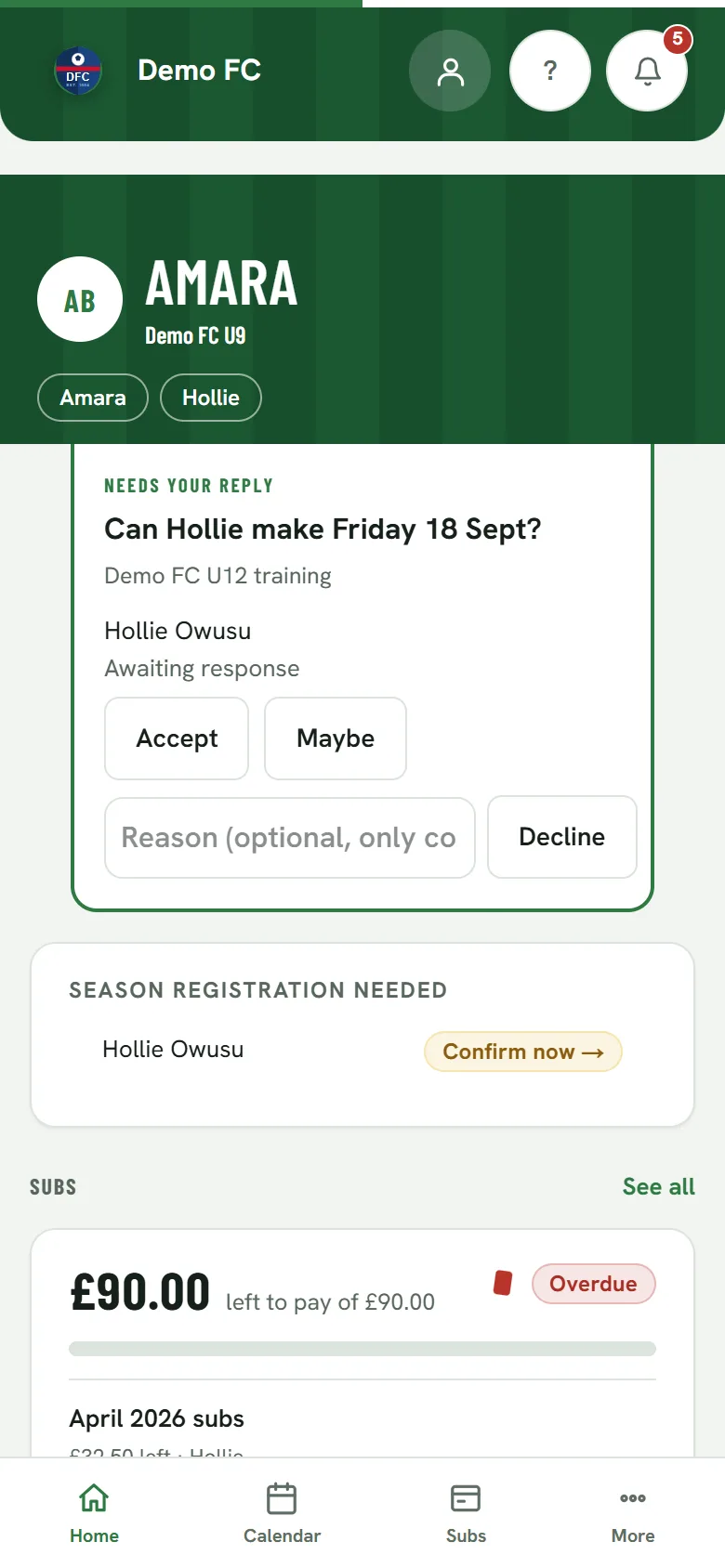
Nobody has replied

  1. You set a reply-by date when you send the invite.
  2. Once it passes, ClubKeeper nudges only the families who haven't answered.
  3. Once each — never a second time, and never for a postponed game.
  4. You open the fixture and see a number, not a WhatsApp thread.

The chasing is the job. This is the part that does it.

Parent · before the season starts

You booked a holiday in October

  1. Put the dates in once, before those fixtures exist.
  2. Every invite created inside that window arrives already declined, marked Away.
  3. Subscribe the fixture list into the calendar on your phone.
  4. It updates itself — including anything postponed or called off.

You never answer the same question twice.

Without another tool

Ten more it already covers

  • Safeguarding casework referrals, and a log nobody can edit after the fact
  • Team sheets and a register medical notes and emergency contacts on one phone screen
  • Season registration the annual reconfirm, with real consent wording
  • Policies and minutes by role, with review dates
  • Club chat and a social wall per team and club-wide, photos included
  • A committee register who holds which office, and since when
  • Parent and guardian logins their own child's fixtures, consents and invoices — and nothing else
  • A home screen showing what still needs doing people waiting to join, checks that have run out, invites nobody answered
  • One account, however many jobs you do treasurer and coach? Switch between the two without a second login
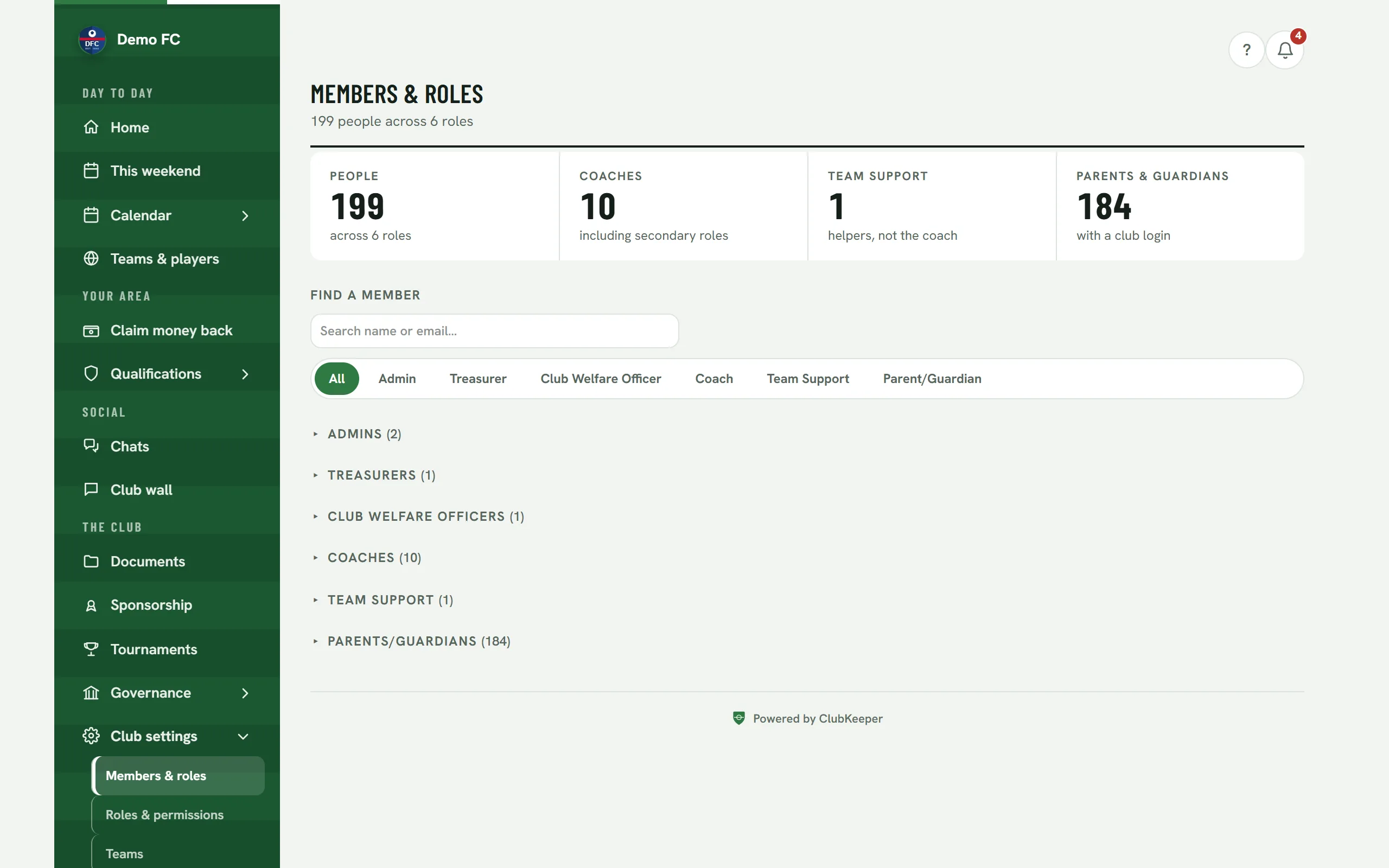
  • A member directory every family and every role, in one search
DBS, PVG or AccessNI — whichever nation you play inTwo-factor for admins, treasurers and welfare officersCSV export, no lock-inTournaments — add-on
How it compares

Count the whole stack, not the subscription

Bill against bill, several platforms look cheaper than ClubKeeper, and some genuinely are. The comparison a treasurer should make is what it costs to get every job below actually done — because the ones that aren’t in the platform don’t stop existing. They move to a second subscription, a spreadsheet, or somebody’s Sunday evening.

What your club needs, compared between ClubKeeper and a typical team app
What your club needsClubKeeperTypical team app
Safeguarding register — every qualification, automatic expiry chasing, concern logSeparate tool
Treasurer’s ledger — expenses, cash book, pay recordsPayments only
Bank reconciliation — import a statement, match it line by lineRarely
Club document library with review datesRarely
Sponsorship & external invoicingRarely
Auto-allocating a whole matchday of pitchesRarely
Tournament hosting, brackets & referee scoring add-onRarely
Your own audit trail — who changed what, and whenPartial
Player subs — weekly, monthly & seasonUsually
Subs paid into the club’s own accountUsually
Calendar, fixtures & chatUsually
Registration forms & consentsUsually
CSV import & export on every ledger and rosterPartial
Xero sync £25/mo add-onComing soonRarely

Swipe the table sideways to see both columns.

We are not your club website. Some platforms include a public site builder; we don’t, and we’re not planning to. ClubKeeper is what sits behind it — keep the website you have, and let this run the club. Fixtures and results export, so the two can agree without being the same product.

Direct Debit isn’t live yet. Subs collect by card today, straight into your own Stripe account. Direct Debit is the next thing we’re building, and if that’s how your club collects, say so when you get in touch and we’ll tell you honestly where it is.

We don’t register players with the FA. ClubKeeper mirrors Whole Game System so you can see where every registration has got to and chase the one thing that is missing. The filing itself still happens on the FA’s own system.

We don’t calculate PAYE. Pay records hold the hours, and the tax and National Insurance exactly as your accountant provides them. ClubKeeper doesn’t work the deductions out, doesn’t check them, and makes no submission to HMRC — operating PAYE stays with the club as employer.

Based on the publicly documented features of the main UK grassroots platforms as at August 2026. They change often, and none of them is bad at what it does — this is about how much of the job one subscription finishes. If we’ve got something wrong, tell us and we’ll correct it.

Children’s data

We don’t read your safeguarding records — and you’ll know if we ever do

We can get into every other part of the system to help you. Safeguarding concerns are the one place that door does not exist — reaching one takes a separate, deliberate exception, not a shortcut through the same route as everything else.

If you ask us for help with oneSomeone here has to write down why, we get one hour, and it shuts itself off. The reason is kept for good.
Your Welfare Officer is told as it opensNot afterwards, and not by us. A club should never learn from ClubKeeper that ClubKeeper read its child protection records.
You can see it on your own screenEvery time we look, it appears in your club’s own record of who did what — with our name on it, next to everything your committee did.
What it costs

One bill, and you can work it out yourself

Priced per club, by how many teams you run. Not per member, not per parent, and never a share of what you collect.

Up to 10 teams
£79
per month
Every part of the platform. Most single-age-group and smaller village clubs sit here.
11 to 22 teams
£149
per month
Where most clubs of a full youth section land. Most clubs
23+ teams
£199
per month — capped
The cap is a promise, not a starting point. Add teams and it does not move.

That is the whole price — ClubKeeper is not VAT registered, so there is no VAT to add. If that changes as we grow, we will tell you at least 90 days before it does.

Never a percentage of your subs. Card payments go straight into your club’s own Stripe account. You pay Stripe’s fee, and nothing to us.
No setup fee, no minimum term. Export everything and leave whenever you want.
Pay annually and get a month free. Timed to your AGM if that is easier.
Two optional add-ons. The tournament engine at £30 one-off, giving you a calendar month’s access, and Xero at £25 a month once that sync is released — not before. Everything else is in the price above.

Not sure which band you are in? Count your teams — that is the whole calculation.

Why we built it

Built by a committee member, for the committee

Jason Cheeseman — Founder & club treasurer

“I’m not a software company that went and researched grassroots clubs. I’m the treasurer at one. Every ledger, every reconciliation and every set of year-end figures in ClubKeeper is here because I had to produce one myself, in a spreadsheet, the night before an AGM. I built what I needed, then what our welfare officer and our secretary needed — because they were sitting at the same table asking me for it.”

And if ClubKeeper stopped tomorrow? Every ledger and roster exports to CSV on demand, today, without asking us — so the answer never depends on us still being here to give it. It is the same export a club uses to leave, and we would rather you could.

Be one of the first clubs on it

ClubKeeper is in private beta with a handful of founding clubs while we get it right. Tell us how many teams you run and the price appears as you type — that is the whole of it. No newsletter, no sequence, no sales call you didn’t ask for.

We’ll only use this to tell you when ClubKeeper opens. See our Privacy Policy.

Or email jason@clubkeeperapp.com